
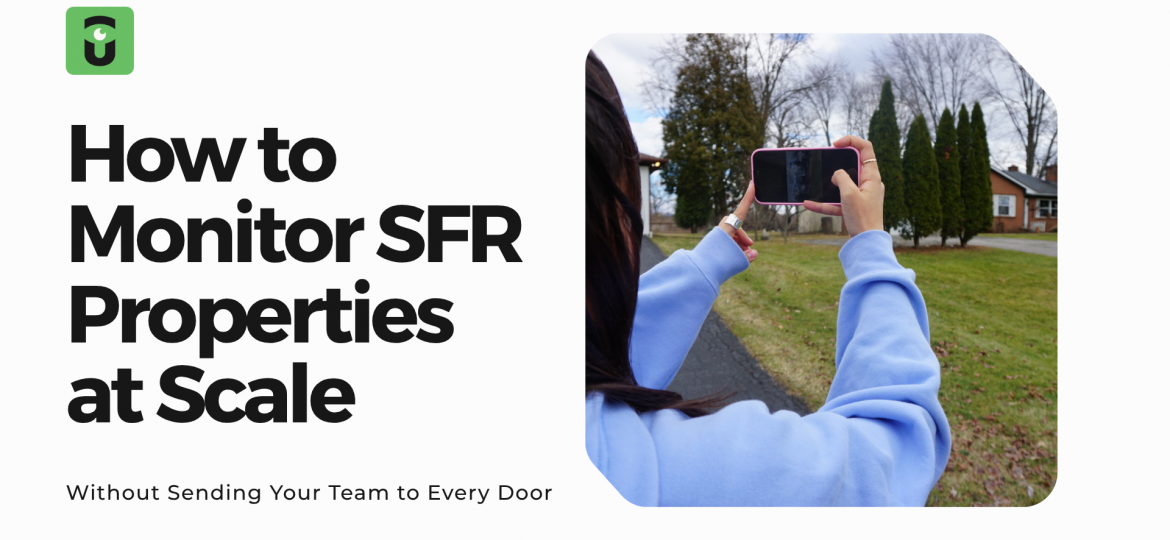
iVueit's nationwide Vuer network covers every zip code — rural and urban — with an average 17.5-hour turnaround for SFR programs.
You manage hundreds of homes — maybe thousands — spread across dozens of zip codes, multiple states, and more submarket conditions than any single team can track. Your occupancy is holding. Your tenants are paying. And somewhere right now, at a property you haven't physically seen in weeks, something is going wrong that nobody has told you about.
That's not a failure of your team. It's a structural problem that comes with operating scattered-site portfolios at scale. And in 2026, with every margin lever tightening simultaneously, it's one that operators can no longer afford to treat as background noise.
The Market You're Operating In Right Now
The single-family rental industry in 2026 is not in crisis — but it is in compression. Demand is structurally intact. Renting an SFR is still roughly $1,000 per month cheaper than owning one, a gap that high interest rates have locked in and that continues to keep occupancy near 96% nationally. The tenant base isn't going anywhere.
What has changed is everything around the edges. National rent growth has flattened to approximately 1% year-over-year as of Q1 2026 — a long way from the 15% annual gains that defined 2021 and 2022. In Sun Belt markets like Miami and Phoenix, where Build-to-Rent supply has hit the market in volume, operators are offering concessions to fill homes that two years ago would have leased in days.
The regulatory environment has shifted just as sharply. A January 2026 Executive Order — "Stopping Wall Street from Competing with Main Street Homebuyers" — set off a wave of legislative action that culminated in the Senate passing the 21st Century ROAD to Housing Act in March 2026. The practical effect for institutional operators: those owning 350 or more homes now face significant restrictions on acquiring additional single-family properties. Growth by acquisition, for a large portion of the industry, is effectively off the table.
What that means operationally is straightforward. You cannot grow your way out of margin compression. You have to operate what you already have — better, leaner, and with more visibility than most current systems allow.
The 2026 SFR squeeze: flat rent growth, restricted acquisitions — but demand holding strong. Operators must optimize the portfolios they have.
Why Scattered-Site Portfolios Create a Visibility Problem That Scales Against You
Here is the problem that every SFR operator at scale eventually runs into, and that almost none of them solve cleanly: the larger your portfolio, the wider the gap between what your records say and what is actually happening at your properties.
Between lease turns, your vacant homes are effectively unmonitored. Between vendor visits, you are relying on the people doing the work — maintenance crews, cleaners, contractors — to tell you whether the work was done, and done correctly. Between PM check-ins, anything can happen. Usually does.
The people closest to your properties have every incentive to report favorably. There is no independent visibility layer between your dashboard and ground truth.
The data bears this out in ways that are difficult to dismiss. In a program covering 556 single-family homes across 182 zip codes, independent physical inspections surfaced conditions at property after property that had gone entirely unreported. Not one of these conditions had been flagged internally before someone physically checked.
Findings from a single iVueit program covering 556 SFR homes across 182 zip codes. None flagged before independent inspection.
That is not a small portfolio with bad management. That is a representative sample of what happens when geographically dispersed assets go unseen for normal periods of time.
The bandwidth problem compounds it. One property manager at a residential PM firm was running 46 inspections over a two-week window trying to maintain a 14-day vacant cadence required by an institutional client. Forty-six inspections. Two weeks. One person. That is what unsustainable looks like — and it is what happens when inspection cadence requirements are met with headcount rather than infrastructure.
"iVueit has made my company's efforts with vacancy checks ten fold smoother and at a much faster pace."
— Jon Barwick
What Invisible Properties Actually Cost in a 1% Rent Growth Environment
At 15% annual rent growth, an operator could absorb a surprising amount of invisible damage. Rents were rising fast enough to paper over deferred maintenance, slow lease-up on properties that weren't quite ready, and the occasional water leak caught a month too late. That math no longer works.
At 1% growth, every invisible loss hits the NOI line directly and stays there.
The longer a problem goes unseen, the more expensive it becomes. At 1% rent growth, there is no margin to absorb it.
The day-count math on vacant properties is unforgiving. A home that sits not-lease-ready for an extra week because nobody knew about a condition preventing it from showing well is a week of rent that cannot be recovered at the end of the year. Multiply that by the number of homes in a portfolio turning over in any given quarter, and the number becomes material quickly.
The compounding losses are worse. An undetected water leak that would have cost $400 to remediate in week one costs multiples of that if it sits for a month. Structural damage, mold risk, subfloor deterioration — deferred detection is deferred cost, and the interest rate on that deferral is steep. An unauthorized occupant — a squatter, a holdover tenant, a trespasser — caught early is a manageable legal and logistical problem. The same situation caught after months is an eviction proceeding in a jurisdiction that may not move quickly, with potential property damage layered underneath it.
Public SFR REITs have deployed over $850 million in share buybacks over the past year, a signal that the market is discounting asset values relative to what operators believe those portfolios are worth. Operators pivoting capital toward Build-to-Rent development and builder partnerships — a direct response to the acquisition restrictions — are concentrating attention on new construction at the same moment existing portfolios need more operational scrutiny, not less.
The properties getting the least attention are the ones accumulating the most undetected risk.
"iVueit is always on point when it comes to assisting with tenant occupancy and addressing squatter homes. Their professionalism and efficiency are unmatched."
How SFR Operators Are Monitoring Properties at Scale Without Expanding Headcount
The answer to the visibility problem is not more staff. Headcount does not scale with a 500-home portfolio, and it certainly does not scale with a 5,000-home one. The answer is an independent visibility layer — one that can reach any property, in any market, on any cadence, without requiring a scheduled visit from someone on your payroll.
How iVueit works: submit, dispatch, capture, deliver — no scheduling, no vendor relationship, no travel required.
On-demand, crowdsourced property inspection works like this: an operator submits a request for any address. A nearby verified inspector — drawn from a network of 500,000+ vetted inspectors covering all 50 states, including rural markets where traditional inspection vendors struggle to staff — is dispatched to capture GPS-tagged, timestamped photos. Every photo is QC-reviewed before delivery. Results are in the operator's portal, or pushed directly into their property management software, with an average turnaround of 17.5 hours for SFR programs. Cost runs $25 to $65 per inspection depending on scope.
This is not a replacement for field teams or property managers. It is what covers the gaps they cannot fill — the 14-day vacant cadence that one PM cannot physically run across 200 homes, the pre-listing condition check that needs to happen before a property goes live, the post-maintenance verification that tells you whether the vendor actually did what the work order says. It integrates directly with AppFolio, Folio, Breezeway, and Streamline, so inspection data flows into the systems operators already use rather than creating a separate process.
Two applications show what this looks like in practice. At one residential property management firm, a single PM was trying to maintain a 14-day vacant cadence across a large portfolio — a requirement from an institutional client that was consuming her capacity entirely. On-demand inspection absorbed the cadence, freed her for higher-value work, and gave the institutional client the independent documentation it was requiring. At another firm, the economics were restructured entirely: a $50 inspection cost was built into a $75 management tier line item, converting what had been overhead into a margin-positive service offering billed directly to clients.
"iVueit has brought value to my job — because of iVueit we are able to assist our prospects in ensuring our homes are vacant, clean, and safe to enter."
— Trudy Medrano
That is the shift worth making in 2026. Not more headcount. Not more manual check-ins. Independent, on-demand visibility across every property in the portfolio — on the cadence the portfolio actually requires, at a cost that fits the margin environment operators are actually in.
Ready to close the visibility gap?
Start Your Solution Assessment
Tell us about your portfolio — size, markets, current inspection cadence — and we'll map exactly where iVueit fits and what a program would cost.
Start Solution Assessment →Book a Discovery Call · No commitment.
